
Methanol is one of the most widely used organic solvents in HPLC and LC-MS workflows. With good solubility for many moderately polar compounds, it is commonly used for sample extraction, elution, reconstitution, and mobile-phase preparation.
In practical analytical workflows, methanol is often mixed with water at different ratios, such as 70:30, 50:50, or 80:20 (v/v). For trace-level or low-concentration analytes, samples often need to be concentrated before injection to reduce solvent volume and increase analyte concentration.
Solvent concentration is therefore an important part of HPLC and LC-MS sample preparation. The stability of this process can directly affect sample recovery, analytical reproducibility, and the reliability of subsequent results.
Challenges in Concentrating Methanol-Water Samples
Methanol and water have significantly different volatility characteristics. Under vacuum and heating conditions, the evaporation behavior of a methanol-water mixture can be influenced by solvent composition, temperature, vacuum level, and sample volume.
If concentration conditions are not properly controlled, several issues may occur:
● Rapid evaporation may cause bumping or sample splashing.
● Small-volume samples may migrate and leave residues on container walls.
● Volatile components may increase the risk of analyte loss during concentration.
● Batch-to-batch consistency may be difficult to maintain when processing multiple samples.
● Inadequate solvent vapor capture may affect the laboratory environment and vacuum system.
For these reasons, an effective concentration system should provide not only sufficient evaporation efficiency but also reliable sample handling, batch-processing capability, and efficient solvent vapor collection.
Limitations of Common Concentration Methods
1. Nitrogen Blowdown
Nitrogen blowdown systems accelerate solvent evaporation by directing a gas stream over the liquid surface. They are relatively simple and suitable for small-scale concentration.
However, when processing multiple small-volume samples, continuous gas flow may cause liquid movement, splashing, or sample residues on the upper walls of the tubes. Operating conditions may also need to be adjusted according to solvent volatility and sample volume. When large amounts of organic solvent are concentrated, laboratory ventilation and solvent vapor management should also be considered.
2. Rotary Evaporation
Rotary evaporators are well suited for the rapid concentration of relatively large solvent volumes, particularly samples ranging from tens of milliliters to larger volumes.
For small-volume, multi-sample workflows, however, operation can be less convenient. Different samples generally require separate evaporation vessels, and careful control is needed to reduce the risk of bumping under high vacuum or rapid evaporation conditions.
Rotary evaporation is therefore often better suited for large-volume pre-concentration rather than multi-tube, small-volume HPLC or LC-MS sample preparation.
3. Freeze Drying
Freeze drying is primarily used for concentrating and drying samples containing large amounts of water.
For samples with a high proportion of organic solvents, suitability should be evaluated according to the specific solvent properties. Methanol, for example, has a very low freezing point, meaning that high-methanol samples require lower freezing temperatures.
Long-term processing of organic solvents may also require consideration of material compatibility and the potential impact of solvent vapor on the vacuum system.
How a Vacuum Centrifugal Concentrator Works
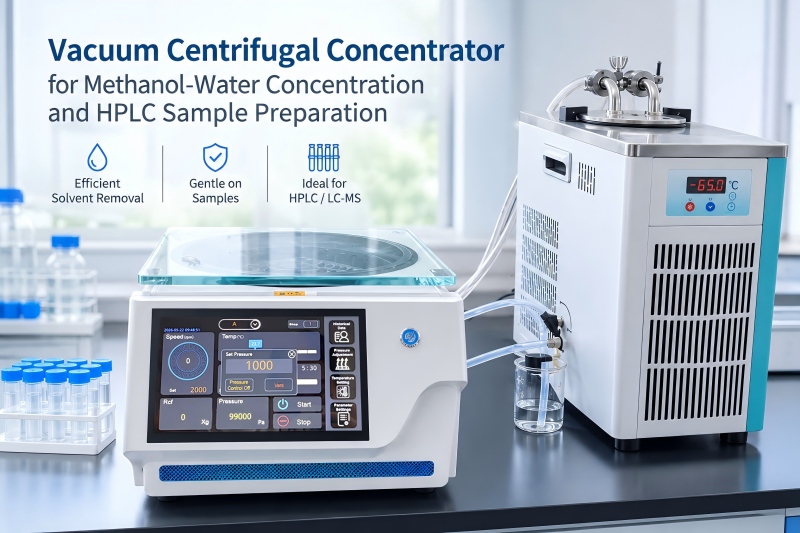
A vacuum centrifugal concentrator combines centrifugal force, vacuum, and controlled heating to remove solvents and concentrate samples efficiently.
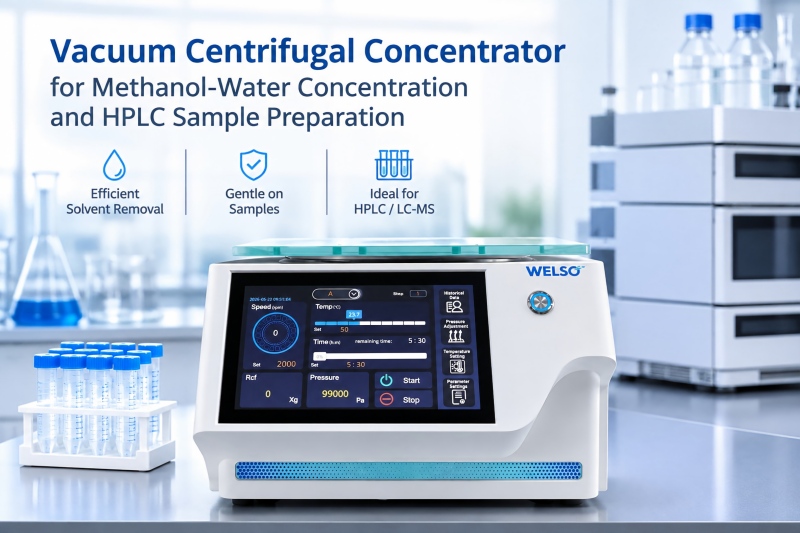
The basic operating principle of the Welso WVA Series Vacuum Centrifugal Concentrator includes the following:
1. Vacuum Lowers the Evaporation Temperature
By reducing the pressure inside the concentration chamber, solvents can evaporate under relatively mild temperature conditions. This allows methanol and methanol-water mixtures to be concentrated with reduced thermal stress compared with conventional high-temperature evaporation.
2. Centrifugal Force Helps Stabilize the Sample
During operation, centrifugal force keeps the liquid at the bottom of the sample container, helping reduce liquid migration, splashing, and sample loss.
This is particularly beneficial for small-volume samples and simultaneous processing of multiple samples.
3. Controlled Heating Improves Evaporation Efficiency
The heating system provides stable conditions to support solvent evaporation. The appropriate temperature should be selected according to methanol content, sample volume, analyte stability, and the required concentration speed.
For samples with a high methanol content, moderate heating combined with suitable vacuum conditions can provide an effective balance between evaporation efficiency and sample stability.
4. A Cold Trap Captures Solvent Vapor
Methanol and other volatile solvent vapors generated during concentration can be condensed and collected by a low-temperature cold trap.
This helps reduce solvent vapor entering the vacuum pump, supports more stable vacuum system operation, and improves solvent vapor management in the laboratory.
Application in Methanol-Water Sample Preparation
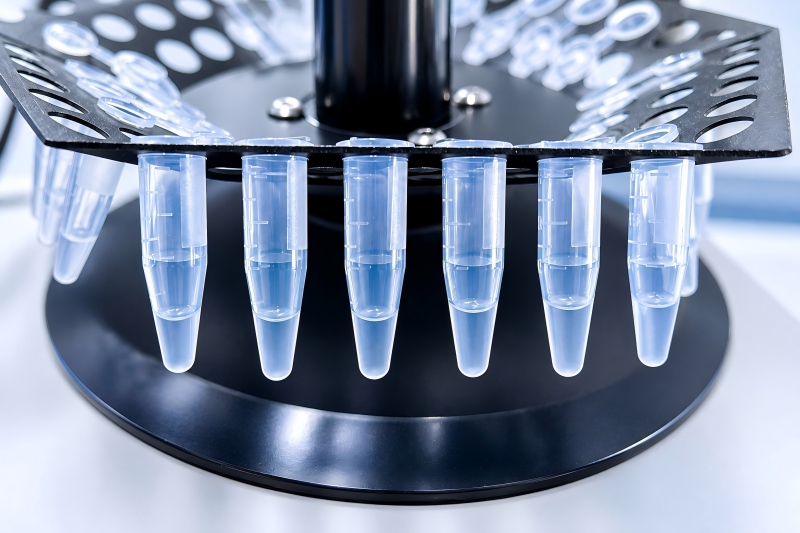
Using a methanol extraction solution at a ratio of 7:3 (v/v) as an example, samples can be transferred into compatible centrifuge tubes or sample vials after extraction and prepared for vacuum centrifugal concentration.
A typical workflow is:
Sample Extraction → Centrifugation or Filtration → Transfer to Concentration Container → Vacuum Centrifugal Concentration → Reconstitution → HPLC / LC-MS Analysis
Compared with handling samples individually, a vacuum centrifugal concentrator can process multiple samples simultaneously, helping improve throughput in routine laboratory sample preparation.
For applications requiring higher analyte concentrations, the final sample volume can be controlled according to the analytical method before reconstitution to the required volume.
Actual operating parameters should always be optimized and validated according to analyte thermal stability, volatility, sample volume, and solvent composition.
Practical Recommendations for Methanol-Water Concentration
Select an Appropriate Cold Trap Temperature
The cold trap temperature should be selected according to the volatility and properties of the solvents being processed.
For methanol and other volatile organic solvents, a cold trap with sufficient low-temperature capture capability is recommended. For samples containing a high proportion of methanol, a cold trap rated at approximately -65°C or below may be selected depending on solvent load and system configuration.
Avoid Using Excessive Heat
Higher temperatures can accelerate solvent evaporation, but they are not necessarily suitable for every sample.
For thermally sensitive or volatile analytes, stable concentration conditions should be achieved by balancing vacuum level, centrifugal operation, and temperature rather than simply increasing the heating temperature.
Consider Material Compatibility for Acidified Samples
For samples containing acidic additives such as formic acid or acetic acid, the compatibility of the chamber, rotor, and related components should be considered according to concentration and frequency of use.
Regular inspection and proper cleaning are recommended to maintain long-term equipment performance.
Clean Collected Solvent Promptly
After each processing batch, the condensed solvent collected by the cold trap should be inspected and removed as required.
Avoiding excessive solvent accumulation helps maintain stable vacuum performance and supports consistent operation between batches.
Advantages of the Welso WVA Series Vacuum Centrifugal Concentrator
Multiple Configurations for Different Laboratory Requirements
The Welso WVA Series is available in different configurations, including basic button-controlled models, versions with integrated diaphragm pumps, acid- and alkali-resistant configurations, and touchscreen-controlled models.
Different configurations can be selected according to laboratory budget, sample characteristics, solvent type, and workflow requirements.
Flexible Rotor Capacity Options
To support different sample volumes and laboratory throughput requirements, the WVA Series offers multiple rotor options, including:
● 1.5 / 2 mL × 132
● 1.5 / 2 mL × 240
● 5 mL × 72
● 10–15 mL × 28
● 100 mL × 8
● 250 mL × 4
Double-layer rotor options are also available for HPLC sample vials:
4 mL × 60
8 mL × 32
For liquid chromatography sample preparation, using compatible sample vial rotors can reduce post-concentration sample transfer steps and help minimize potential sample loss or contamination during handling.
Multiple Cold Trap Temperature Options
The Welso WVA Series offers different cold trap temperature configurations, covering approximately -50°C to -110°C for different solvent applications.
Laboratories can select an appropriate configuration based on the properties of methanol, acetonitrile, dichloromethane, and other volatile solvents to support efficient vapor capture and help protect the vacuum system.
In HPLC and LC-MS sample preparation, concentration is more than simply removing solvent. It is an important process that can influence sample recovery, processing efficiency, and analytical reproducibility.
For methanol-water systems, vacuum centrifugal concentration combines reduced-pressure evaporation with centrifugal sample stabilization, controlled heating, and low-temperature solvent capture. This provides a practical solution for batch processing of small-volume samples commonly encountered in laboratory analytical workflows.
With multiple equipment configurations, rotor capacities, and cold trap temperature options, the Welso WVA Series Vacuum Centrifugal Concentrator can be configured for different sample volumes, solvent systems, and analytical workflows, providing flexible support for HPLC, LC-MS, and other laboratory sample preparation applications.



Email: info@welsobio.com
Tel: +86 21 51096910
Head Office: No. 439 Jinglian Road, Minhang District, Shanghai,China, 201108
Branch: 1-1009, National Industrial Design Park, No. 599 Jianzhu Road, Binhu, Wuxi , Jiangsu, China, 214062

Follow official account