
1. Why Does Centrifugation Affect Cell Experiment Results?
Centrifugation is widely used in cell culture, cell harvesting, and biological sample preparation to separate cells from culture media, collect cell pellets, and prepare samples for downstream analysis. Inconsistent centrifugation conditions or handling procedures may lead to variable cell recovery, loose pellets, or residual cells in the supernatant.
These issues are not necessarily caused by the centrifuge itself. Sample characteristics, relative centrifugal force (RCF), run time, temperature, rotor configuration, and resuspension techniques can all influence the outcome.
Troubleshooting should therefore consider the sample, experimental objective, and entire workflow rather than rotational speed alone.
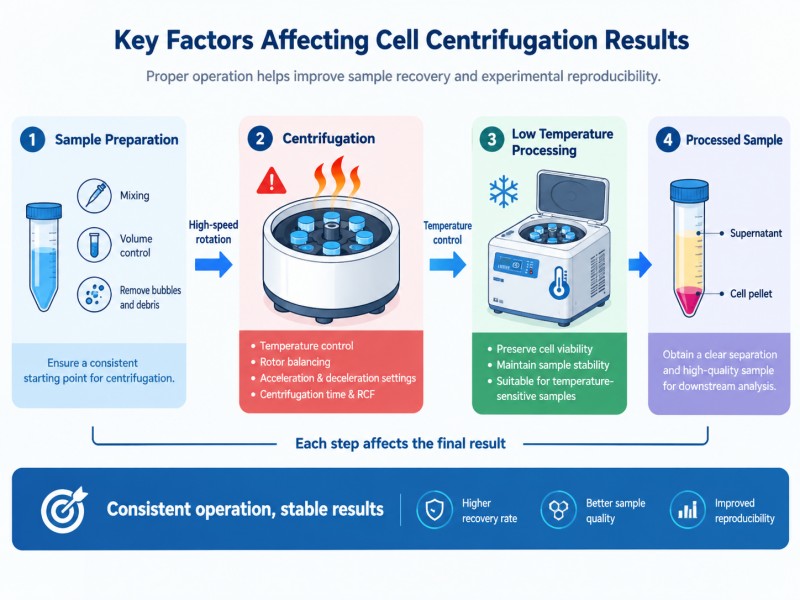
2. Temperature Control: Match Conditions to Sample Requirements
High-speed rotor rotation can generate heat through mechanical losses and air resistance. For temperature-sensitive cells and biological materials, temperature control may affect sample integrity. However, refrigerated centrifugation is not necessary for every sample.
Key practices:
●Confirm temperature requirements: Follow a validated protocol appropriate for the cell type and sample.
●Pre-cool when required: Allow sufficient time for the centrifuge to reach the intended operating conditions, following the manufacturer's instructions.
●Minimize unnecessary delays: Keep sample handling before and after centrifugation consistent, especially for temperature-sensitive materials.
●Record relevant parameters: When results vary between batches, compare temperature, run time, and sample handling time.
Lower temperatures do not automatically improve cell viability. The appropriate setting depends on the sample and experimental objective.
3. Rotor Balancing: Ensure Safe and Stable Operation
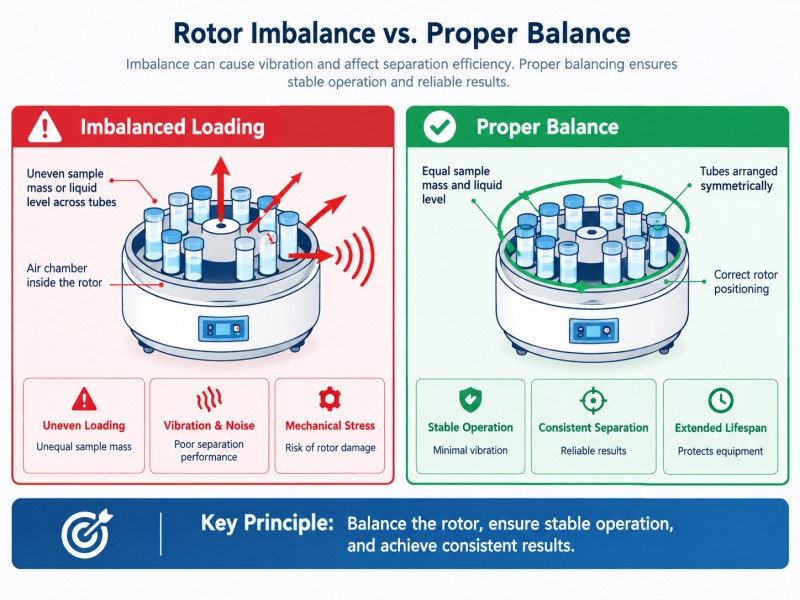
Uneven mass distribution across centrifuge tubes creates an imbalance during rotation. This can cause vibration and increase mechanical stress on the rotor, drive system, and sample containers. Severe imbalance may trigger a safety shutdown or damage the equipment.
Key practices:
●Load samples symmetrically according to the rotor manufacturer's instructions.
●Balance tubes by mass rather than relying on liquid levels alone.
●Verify that tubes, caps, and adapters are compatible with the rotor and intended operating conditions.
●Follow the manufacturer's loading requirements when using a partially filled rotor. Do not assume that an arbitrary empty tube or counterweight is suitable.
If unusual vibration, noise, or an alarm occurs during operation, stop the centrifuge safely and wait until the rotor has come to a complete stop before inspecting the load, rotor installation, and tube compatibility. Never continue running the centrifuge in an attempt to eliminate abnormal vibration.
Rotor balancing primarily protects equipment and supports stable operation. It does not, by itself, guarantee cell viability or sample purity.
4. Acceleration and Deceleration: Balance Separation Quality and Efficiency
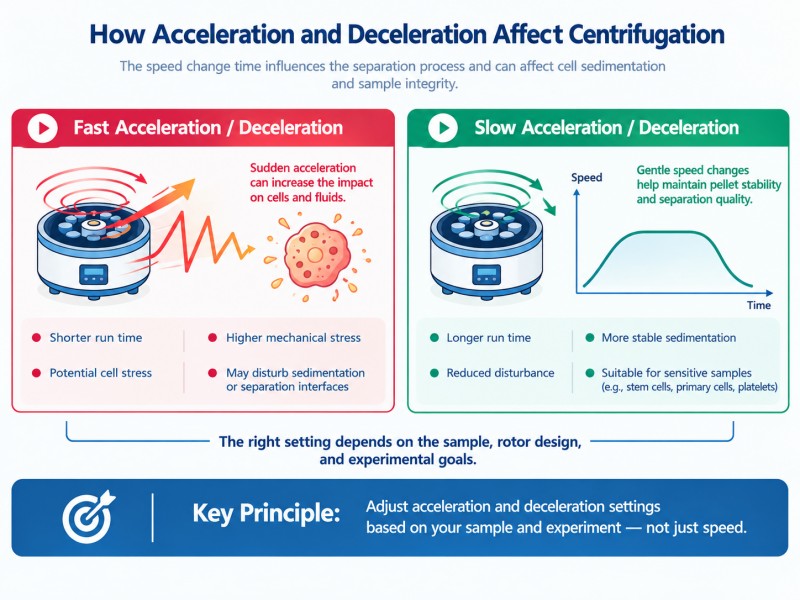
Acceleration and deceleration settings affect the time required to reach or leave the target speed. Depending on the sample, they may also influence pellet stability or the integrity of a separation interface.
Rapid acceleration or deceleration does not necessarily damage cells. The appropriate settings depend on sample characteristics, rotor design, and the validated experimental protocol.
For samples with loose pellets or sensitive separation interfaces, a more gradual deceleration profile may help reduce disturbance. For routine cell harvesting, the settings should follow established conditions appropriate for the application.
If pellets appear poorly formed, the supernatant remains cloudy, or recovery varies between runs, review RCF, run time, sample condition, and deceleration settings together. A controlled comparison with other conditions held constant is more reliable than attributing the result to a single parameter.
5. Centrifugation Time and Force: Look Beyond RPM
Centrifugation time affects the extent of sedimentation. Insufficient time may leave target cells in suspension, but simply extending the run is not a universal solution. Suitable conditions also depend on sample properties, centrifugal force, rotor geometry, and the intended separation.
RPM vs. RCF: What Is the Difference?
RPM (revolutions per minute) describes rotor speed, whereas RCF (relative centrifugal force) describes the acceleration experienced by the sample relative to gravity. RCF depends on both rotational speed and the effective rotor radius.
For example, at 3,000 rpm, a rotor with an effective radius of 10 cm generates approximately 1,006 × g, while a rotor with an effective radius of 15 cm generates approximately 1,509 × g. The same RPM setting therefore does not necessarily produce the same centrifugal force.
When transferring a protocol to another centrifuge or rotor, do not assume that the original RPM setting will reproduce the same separation conditions.
Practical recommendations:
●If the protocol specifies RCF, use it as the primary reference when checking operating conditions.
●When changing rotors, verify the effective radius and the compatibility of tubes and adapters.
●If only RPM is provided, confirm the specifications of the original rotor before converting the setting.
●Validate centrifugation time against the experimental outcome rather than extending it without verification.
Always follow the validated protocol and the centrifuge manufacturer's operating limits.
6. Sample Preparation: Keep Initial Conditions Consistent
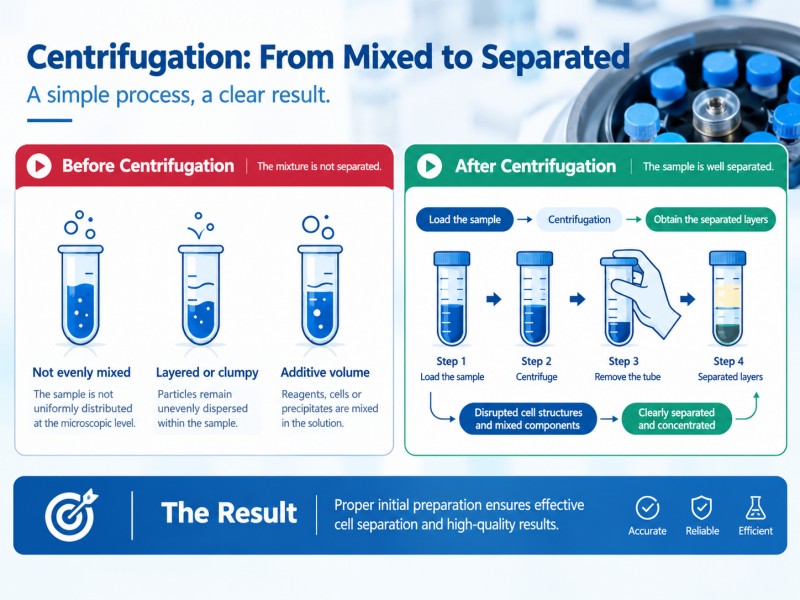
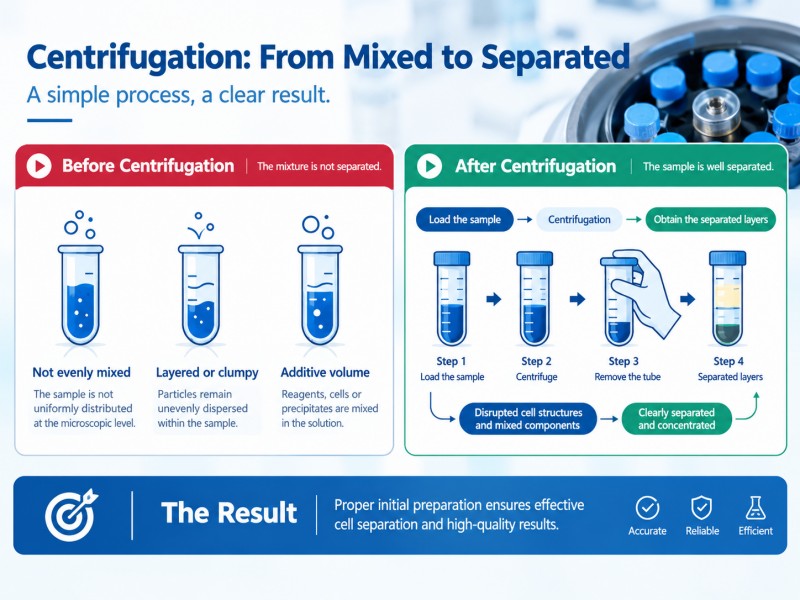
Centrifugation cannot compensate for inconsistencies introduced during sample preparation. Uneven cell distribution, aggregation, differences in sample volume, and processing delays may all affect recovery.
Key practices:
●Standardize mixing: Use a method appropriate for the sample and avoid unnecessary vigorous shaking or excessive pipetting.
●Control sample volume: Follow tube and rotor loading limits, and confirm compatibility with the selected equipment.
●Inspect sample condition: Evaluate visible aggregates, bubbles, or particles when relevant. Filtration and bubble removal are not appropriate for every sample and may cause target material loss in some workflows.
●Control processing time: For time-sensitive samples, keep the interval between collection, preparation, and centrifugation as consistent as possible.
Sample preparation should be tailored to the sample type and experimental purpose rather than applying the same additional steps to every workflow.
7. Troubleshooting Common Centrifugation Problems
When an unexpected result occurs, document the observation first and then examine possible causes systematically. Avoid changing multiple parameters at once.
Observed issue | Possible contributing factors | Recommended checks |
Target cells remain in the supernatant | Insufficient sedimentation or unsuitable centrifugation conditions | Verify RCF, run time, and rotor configuration |
Pellet is disturbed | Loose pellet, unsuitable deceleration, or improper supernatant removal | Review deceleration settings and supernatant removal technique |
Reduced cell viability | Digestion, processing delays, temperature, centrifugation, or resuspension | Compare viability before and after processing and review each step |
Inconsistent results between batches | Variations in preparation, centrifugation settings, or counting methods | Compare records and standardize critical steps |
Unusual vibration during operation | Imbalance, incompatible consumables, or improper rotor installation | Stop operation safely and inspect according to the manual |
Unusually cloudy supernatant | Incomplete sedimentation, cell debris, or other suspended particles | Inspect the sample and determine the source of turbidity |
These observations can have multiple causes. Interpret them in the context of the sample, equipment configuration, and experimental records rather than drawing conclusions from a single symptom.
8. Standardize Centrifugation Records
Consistent recordkeeping makes it easier to compare experimental batches, identify variations, and reproduce successful conditions.
Record category | Information to document |
Sample information | Cell type, passage number, and initial volume |
Equipment configuration | Centrifuge, rotor, tubes, and adapters |
Operating parameters | RCF or RPM, run time, temperature, and acceleration/deceleration settings |
Sample preparation | Mixing method, processing delays, and other critical steps |
Experimental results | Pellet appearance, supernatant condition, cell count, and viability when applicable |
When results deviate from expectations, compare the current run with records from successful experiments. Where practical, change one major variable at a time and use appropriate replicate experiments to evaluate its effect.
9. How to Choose the Right Centrifuge for Your Application
●Centrifuge selection should consider sample type, required RCF, processing volume, temperature requirements, rotor compatibility, and throughput—not maximum RPM alone.
●Low-speed centrifuges: Suitable for routine cell harvesting and basic separation within the instrument's operating range.
●Refrigerated centrifuges: Appropriate for workflows that require temperature control.
●High-speed centrifuges: Designed for applications requiring higher centrifugal forces within the specified equipment and rotor limits.
●Large-capacity centrifuges: Suitable for workflows involving larger sample volumes or higher processing throughput.
Before selecting a system, review rotor options, maximum permitted speed, RCF range, temperature control, acceleration/deceleration settings, and safety features.
Welso offers centrifuges for a range of laboratory sample-processing requirements. The appropriate model should be evaluated against the intended application, rotor configuration, and technical specifications. Reliable results also depend on correct balancing, suitable operating parameters, and consistent sample handling.
Conclusion
Reliable cell centrifugation depends on sample characteristics, equipment configuration, operating parameters, and the surrounding handling workflow. Temperature control, rotor balancing, acceleration and deceleration, centrifugation time, and sample preparation are all relevant when investigating inconsistent results.
When cell recovery, pellet formation, or viability changes unexpectedly, assess the complete workflow rather than assuming a single parameter is responsible. Standardized procedures, consistent records, and controlled validation can help laboratories identify contributing factors and improve the reproducibility of cell processing.



Email: info@welsobio.com
Tel: +86 21 51096910
Head Office: No. 439 Jinglian Road, Minhang District, Shanghai,China, 201108
Branch: 1-1009, National Industrial Design Park, No. 599 Jianzhu Road, Binhu, Wuxi , Jiangsu, China, 214062

Follow official account