
When discussing the WHR1601 high-speed refrigerated centrifuge with customers, we have found that, in addition to basic parameters such as speed, capacity, and temperature, rotor and adapter selection is also a common concern. Different sample types, centrifuge tube specifications, and experimental purposes may require different rotor configurations.
This guide summarizes the key factors customers consider during rotor selection, helping users choose suitable centrifuge rotors and adapters more clearly.
Proper rotor selection should be based on actual experimental needs. A suitable combination of rotor, centrifuge tube, and adapter can provide safer, more stable, and more reliable centrifugation results.
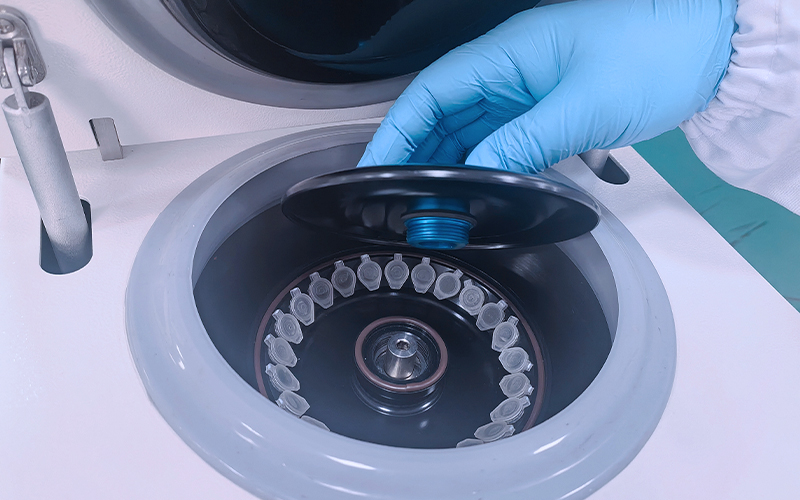
1. The First Step in Rotor Selection: Define Your Centrifugation Purpose
Before choosing a rotor, first identify what you want to achieve through centrifugation. Different purposes require different centrifugal forces, sample capacities, and separation results.
Common purposes include:
● Cell, DNA/RNA, or protein precipitation
● Particle separation or sample concentration
● Processing blood, cell culture media, and similar samples
● Density-based separation of different components
When selecting a rotor, consider the sample type, processing volume, required RCF, centrifugation time, and whether you need to collect pellets, supernatant, or separated layers. Once these requirements are clear, you can select the appropriate rotor and adapter.
2. Sample Volume Determines the Rotor Capacity Range
Common centrifuge tube sizes include 1.5/2.0/2.2 mL, 5 mL, 10 mL, 15 mL, 50 mL, 100 mL, and 250 mL. Different tube capacities correspond to different rotor structures, tube positions, and operating parameters.
● Small-volume samples: DNA, RNA, proteins, and other molecular biology samples commonly use 1.5–2.2 mL tubes and are typically paired with small-capacity fixed-angle rotors.
● Medium-volume samples: Cell suspensions and general biological samples commonly use 5–50 mL tubes. Fixed-angle or swing-out rotors can be selected according to the required RCF.
● Large-volume samples: Culture media, blood, and other biological liquids commonly use 100–250 mL tubes. Rotor capacity and separation performance should receive greater attention.
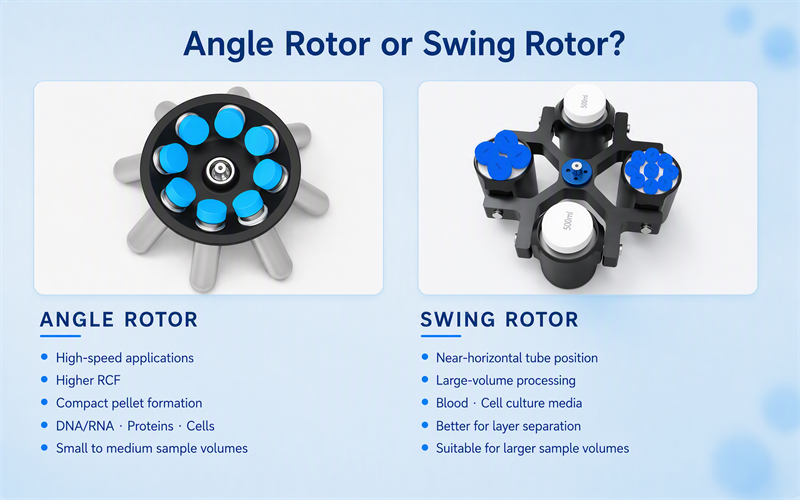
3. Fixed-Angle Rotor or Swing-Out Rotor?
During operation, centrifuge tubes in a fixed-angle rotor remain at a fixed angle. This type of rotor is commonly used for high-speed and high-RCF applications. It helps form compact pellets and is suitable for DNA/RNA, proteins, cells, and particle samples.
In a swing-out rotor, the tubes gradually move to a near-horizontal position during operation. It is better suited for large-volume samples, blood, cell culture media, and applications requiring layer separation. Its advantage is not necessarily a higher RPM, but rather larger single-tube capacity and a separation method suitable for specific samples.
Therefore, the choice between a fixed-angle rotor and a swing-out rotor should be based on the purpose of the experiment.
4. How to Choose Between Conical-Bottom and Round-Bottom Centrifuge Tubes
The bottom shape of a centrifuge tube affects pellet formation, sample recovery, and compatibility with rotors and adapters.
Conical-bottom tubes are suitable for cell, DNA/RNA, protein, and fine-particle samples that require pellet recovery. The pellet is more easily concentrated at the bottom of the tube, making it easier to observe, collect, and resuspend.
Round-bottom tubes are commonly used for routine sample separation, cell suspensions, blood samples, and large-volume samples where a concentrated pellet is not the main requirement.
It is important not to judge a tube’s allowable speed based only on whether it has a conical or round bottom. Its safe operating range also depends on its material, wall thickness, dimensions, temperature, and the manufacturer’s testing and certification conditions. Always confirm that the centrifuge tube, rotor, and adapter are compatible, and follow the tube manufacturer’s specified maximum RPM and RCF.
5. Why Rotor Selection Should Not Be Based on RPM Alone
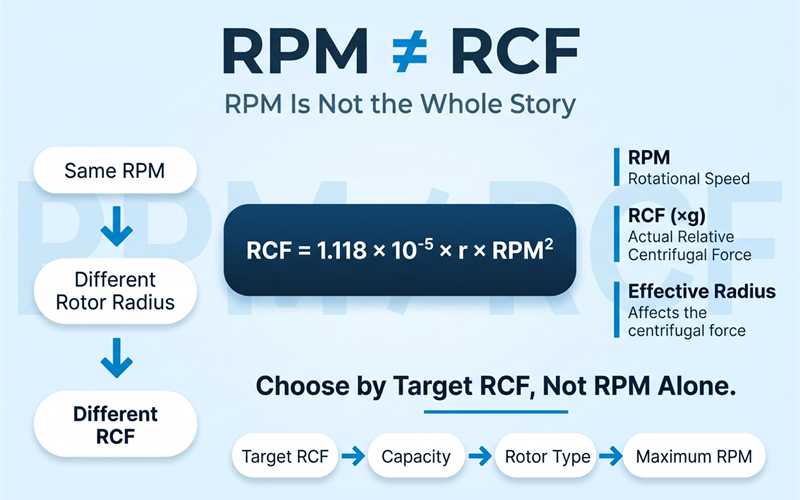
RPM refers to rotational speed, but it does not directly represent the centrifugal force experienced by the sample. RCF, or Relative Centrifugal Force, is the more relevant parameter and is usually expressed as ×g.
RCF calculation formula:
RCF = 1.118 × 10⁻⁵ × r × RPM²
Where:
RCF: Relative Centrifugal Force
r: Effective centrifugation radius
RPM: Rotational speed
Because different rotors have different radii, the same RPM may produce different RCF values. Therefore, rotor selection should follow this order:
Target RCF → Required capacity → Rotor type → Maximum RPM
6. Why High-Speed and Large-Capacity Rotors Usually Cannot Be Combined
As rotor capacity increases, the weight of each sample tube, total load, and rotational inertia also increase. This places greater demands on the rotor’s structural strength. Therefore, a larger capacity does not necessarily mean a higher speed.
For example, the same high-speed refrigerated centrifuge may use different rotors: small-capacity rotors are suitable for higher speeds, while 50 mL and 100 mL rotors place greater emphasis on load capacity and practical application needs. This is a normal design difference and does not indicate lower product performance.
7. How Does Rotor Material Affect Selection?
Rotor material is also an important factor in rotor design and selection.
Common materials used in Welso centrifuge rotors include aluminum alloy, aluminum alloy combined with carbon fiber, and stainless steel.
Aluminum alloy offers a good balance of strength, weight, and thermal conductivity and is commonly used in high-speed rotors. Aluminum alloy combined with carbon fiber is lighter and may be used in some large-capacity or swing-out rotors. Stainless steel is commonly used for tube racks and adapter structures.
No material is absolutely better than another. The choice should still be based on speed, capacity, structure, and experimental requirements.
8. Why Are Adapters Important?
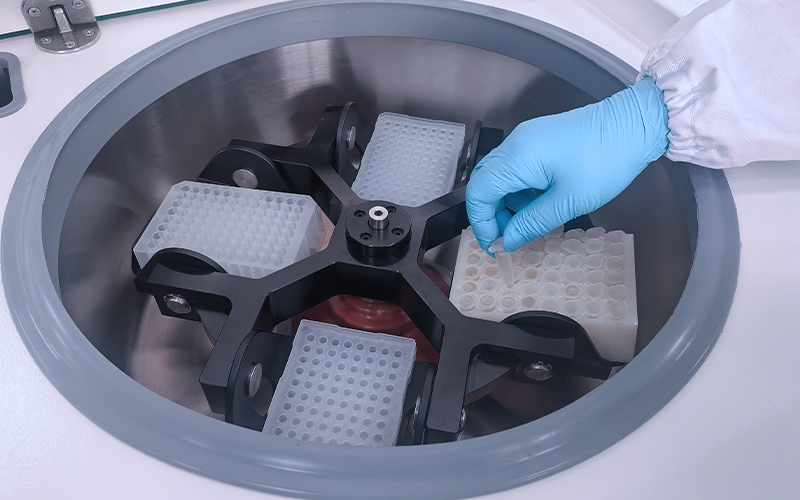
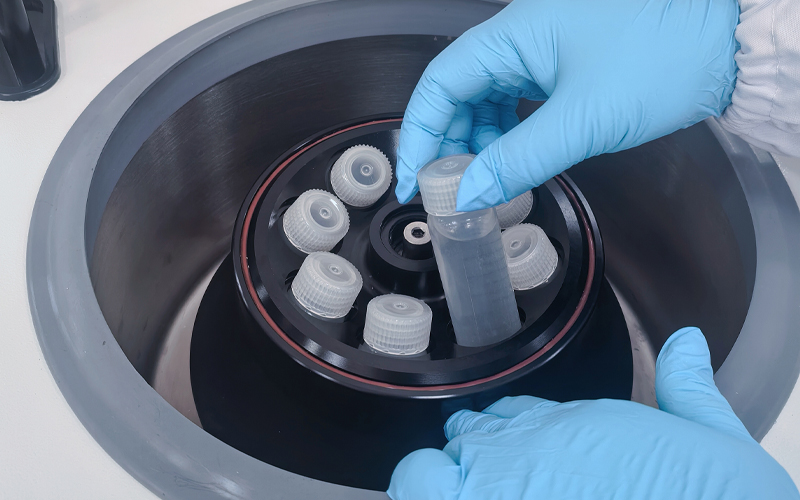
Rotor holes may not directly fit the centrifuge tubes used in the laboratory, making adapters an essential part of the overall configuration.
When selecting an adapter, confirm:
Centrifuge tube capacity, diameter, and length
Conical, round, or other special tube-bottom structures
Whether the tube can be securely supported
Whether the maximum RPM/RCF ratings of the tube, adapter, and rotor meet the actual operating requirements
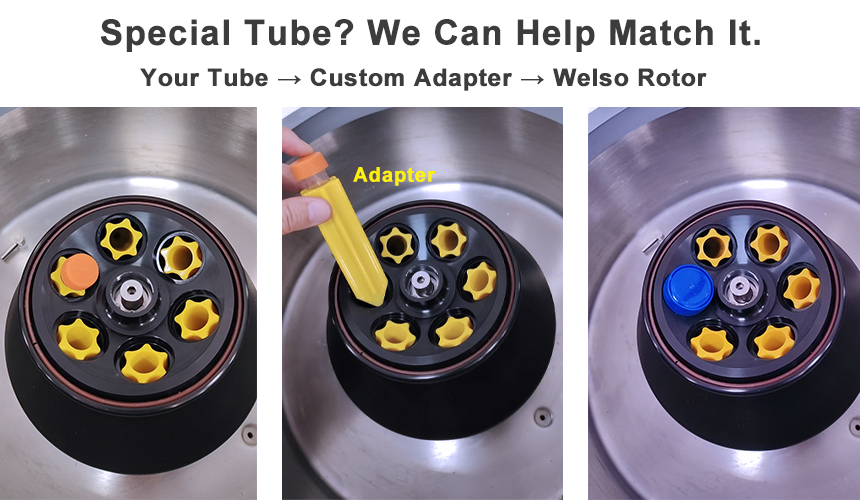
9. Custom Adapters for Special Centrifuge Tubes
For centrifuge tubes with special dimensions, non-standard capacities, unusual bottom structures, or different brand specifications, custom adapters can be evaluated as long as the rotor’s rated operating conditions are met.
Customers can provide the tube capacity, outer diameter, length, bottom structure, and target RCF. Welso can then evaluate a suitable adapter solution.
10. A Complete Rotor Selection Process
The selection process can be simplified into the following steps:
▶ Identify the sample type
▶ Determine the sample volume
▶ Confirm the centrifuge tube specifications
▶ Define the centrifugation purpose
▶ Determine the required RCF
▶ Select the rotor type
▶ Select the adapter
▶ Confirm the safe operating range
By following these eight steps, laboratories can select centrifuge rotors that are better matched to their experimental requirements.
Choose the Right Rotor for More Stable and Efficient Experiments
A suitable combination of rotor, centrifuge tube, and adapter can help laboratories achieve more reliable pellet formation, separation, or layering results while reducing sample loss and operational risks.
With years of experience in centrifuge research, development, and manufacturing, Welso can provide standard rotors and customized adapter solutions based on sample type, centrifuge tube specifications, target RCF, and practical application requirements, helping laboratories achieve safer and more stable centrifugation configurations.



Email: info@welsobio.com
Tel: +86 21 51096910
Head Office: No. 439 Jinglian Road, Minhang District, Shanghai,China, 201108
Branch: 1-1009, National Industrial Design Park, No. 599 Jianzhu Road, Binhu, Wuxi , Jiangsu, China, 214062

Follow official account