
Introduction to Welso Planetary Ball Mills
A planetary ball mill is a high-performance laboratory grinding device used for sample size reduction, mixing, and ultrafine powder preparation. Its planetary motion design allows the grinding jars to rotate around the main axis while spinning on their own axes. This creates intensive impact, friction, and shear forces between the grinding media and the sample for efficient grinding and homogenization.
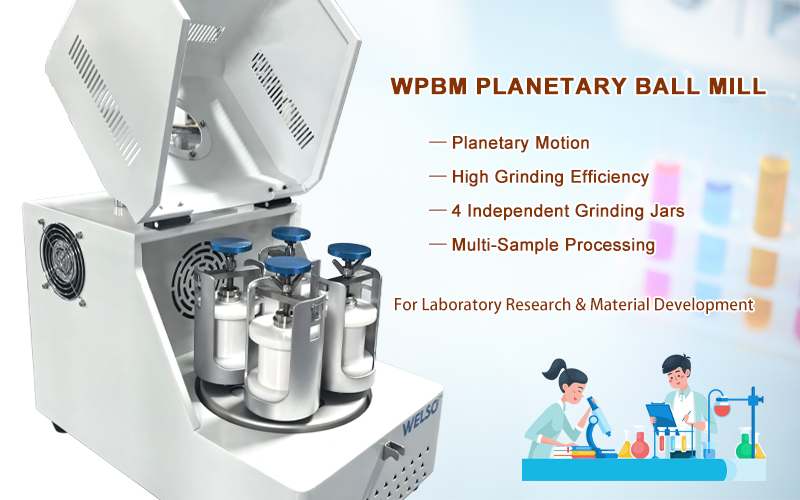
The Welso WPBM Series planetary ball mill features a compact structure, convenient operation, and efficient grinding performance. It is suitable for laboratory research, small-scale production trials, material analysis, soil testing, and educational applications. The system can accommodate four independent grinding jars at the same time, allowing multiple samples to be processed in one run while helping reduce cross-sample interference.
For complete configurations and technical specifications, please visit the Welso WPBM Series Planetary Grinder product page.
WPBM Series Models and Grinding Capacity
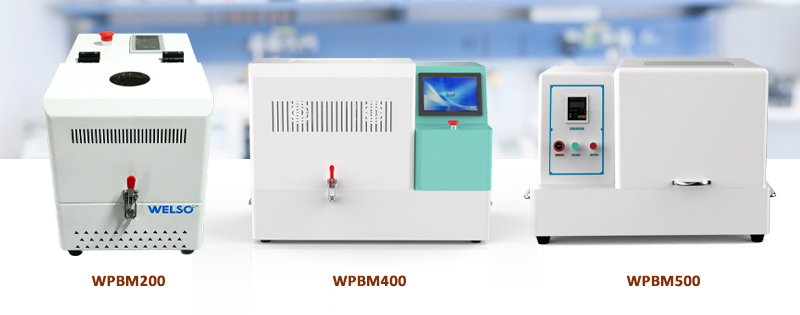
Model | Batch Capacity | Recommended Applications |
WPBM-200 | 4 × 100 mL | Small samples, routine laboratory work, and low-volume sample preparation |
WPBM-400 | 4 × 1500 mL | General laboratory grinding and medium-batch sample processing |
WPBM-500 | 4 × 3000 mL | Larger batches, research applications, and higher-throughput sample preparation |
The WPBM Series is designed for laboratory samples with relatively small feed sizes. For the WPBM-200, the recommended feed size is below 10 mm for soil samples and below 3 mm for other materials. For the WPBM-400 and WPBM-500, the recommended feed size is below 10 mm.
With suitable sample properties, grinding media, and operating parameters, final fineness can reach below 100 nm. The system supports both dry and wet grinding to meet a wide range of laboratory sample-preparation requirements.
Key Advantages of the Planetary Ball Mill
1. High-Energy Grinding for Fine Sample Preparation
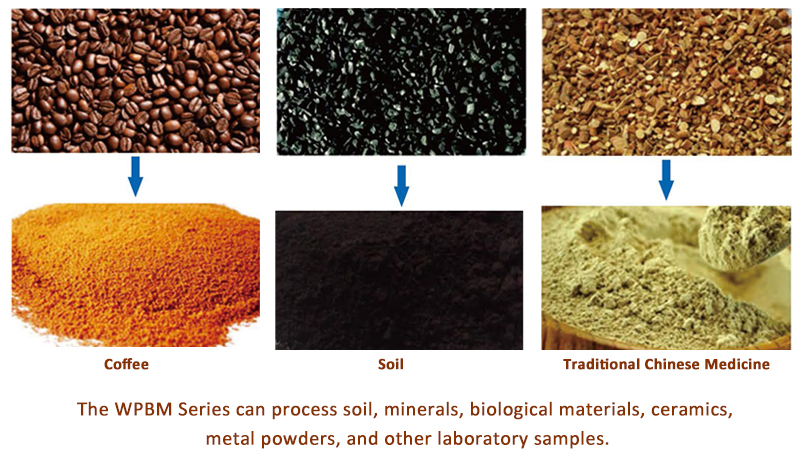
The planetary motion mechanism enhances the impact and friction between the grinding balls and the sample. It is suitable for applications requiring fine particle sizes and high sample uniformity. For materials such as soil, ores, ceramics, metal powders, and plant materials, users can adjust grinding time and speed to achieve the desired results.
2. Four Independent Jars for Improved Efficiency
The four-jar design allows several samples to be processed simultaneously in a single experiment. Different materials or sample sources can be loaded into separate jars, helping improve laboratory throughput and reduce the risk of sample interaction.
3. Gear Drive for Better Repeatability
The gear drive system supports stable operation and helps maintain consistent grinding conditions between batches. This is particularly valuable for research, testing, and material development applications where repeatable sample preparation is important.
4. Digital Parameter Setting and Easy Operation
The unit features digital timing control, with a grinding time setting range of 1–99 minutes and continuous operation capability. The sun wheel speed is adjustable from 50 to 400 r/min, while grinding jar speed ranges from 100 to 800 r/min. Users can select appropriate settings according to sample hardness, loading volume, and target particle size.
5. Multiple Grinding Jar and Media Options
The Welso WPBM Series can be configured with grinding jars and balls made from a variety of materials, including 304/316 stainless steel, tungsten carbide, agate, PTFE, PP, PA, zirconium oxide, and corundum.
Grinding ball diameters are available in 3 mm, 5 mm, 10 mm, 15 mm, and 20 mm. Users can select suitable grinding media based on sample hardness, target fineness, and contamination-control requirements.
6. Sealed, Dust-Resistant Grinding Chamber
The grinding chamber is designed to help reduce dust exposure and includes an observation window for monitoring operation. The WPBM-500 also features chamber lighting for more convenient observation of the grinding jars during use.
Applications of the Planetary Ball Mill
Welso planetary ball mills are suitable for grinding, mixing, and fine processing of hard, brittle, fibrous, and composite materials. Typical applications include:
Pharmaceutical and herbal materials: ginseng, dendrobium, tablets, medicinal preparations, licorice, and more;
Biological samples: plant raw materials, bone, tobacco, pearls, and more;
Inorganic materials: glass, iron powder, aluminum powder, magnesium powder, ceramics, alumina, metal oxides, alloys, graphite, and more;
Organic materials: coke, coal, ink, cellulose, carbon fiber, sludge, wood, and more;
Ores and construction materials: iron ore, kaolin, limestone, gypsum, quartz, minerals, clay minerals, soil, cement clinker, concrete, and slag;
Other laboratory samples: paper, chips, polymers, pigments, fiber products, catalysts, chemicals, and waste samples.
For soil testing, environmental monitoring, and agricultural research, a planetary ball mill is particularly useful for homogenizing and finely grinding soil, sediment, and clay mineral samples before elemental analysis, composition testing, or other sample-preparation procedures.
Recommended Operating Environment
To ensure stable operation, the planetary ball mill should be installed in a well-ventilated indoor environment and operated under the following conditions:
Ambient temperature: 0°C to 40°C;
Avoid corrosive gases, excessive humidity, direct sunlight, and heavy dust;
Use a stable power supply with voltage fluctuations within ±10% of the rated voltage;
Place the equipment on a level, stable workbench;
Allow sufficient space around the unit for heat dissipation and operation.
Basic Operating Procedure
Select suitable grinding jars and grinding balls according to sample properties.
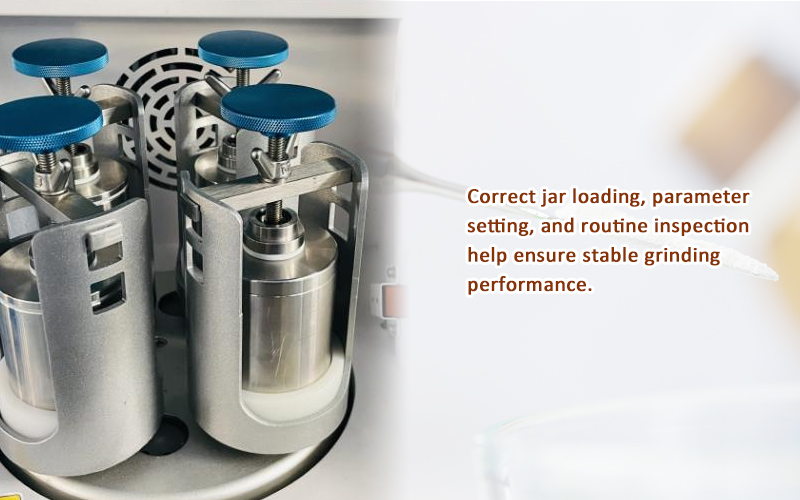
Load the sample and grinding balls into the grinding jar, then install and secure the jar correctly.
Close the safety cover and set the grinding time, speed, and other operating parameters.
Start the equipment and complete the grinding process.
After the machine stops, remove the sample and clean the grinding jars, grinding balls, and related components promptly.
Operating Precautions
After the equipment has operated at high speed for approximately three minutes, check whether the grinding jar fastening mechanism is loose. If necessary, re-tighten it before continuing operation.
The speed displayed on the main interface is the set operating speed. Actual grinding performance is also influenced by sample hardness, sample loading, ball-to-powder ratio, grinding time, and grinding media.
Higher speed does not always produce better grinding results. Excessive speed may accelerate wear of mechanical parts and shorten equipment service life. Select the lowest practical speed that achieves the required fineness.
Inspect the equipment regularly during operation. Stop the machine immediately for inspection if abnormal noise, excessive vibration, loose jars, or other irregular conditions occur.
For trace-element analysis or applications sensitive to metal contamination, select appropriate jar and grinding ball materials to avoid interference with the sample.
Frequently Asked Questions
Can a planetary ball mill be used for soil grinding?
Yes. The Welso WPBM Series is suitable for homogenizing and finely grinding soil, clay minerals, sediment, and other environmental samples. Grinding time, speed, and jar material should be selected according to soil moisture, particle hardness, and the intended downstream analysis.
How should I choose between WPBM-200, WPBM-400, and WPBM-500?
The WPBM-200 is suitable for small samples and routine laboratory preparation. The WPBM-400 is a practical choice for general laboratory capacity requirements. The WPBM-500 is better suited to larger batches and higher-throughput sample processing.
Does the planetary ball mill support dry and wet grinding?
Yes. The WPBM Series supports both dry and wet grinding. Wet grinding can be considered for materials that generate dust, oxidize easily, or require dispersion during processing.
How should I choose grinding jars and grinding balls?
The selection should be based on sample hardness, target particle size, sample quantity, and contamination-control requirements. Stainless steel is durable and suitable for many general samples, while agate, zirconium oxide, or PTFE can be considered for applications with stricter metal-contamination requirements.
The Welso WPBM Series planetary ball mill provides a compact, efficient, and user-friendly solution for ultrafine powder preparation, soil grinding, material research, and laboratory sample preparation. By selecting the appropriate model, grinding media, and operating parameters, users can achieve reliable size reduction and homogenization for a wide range of materials.



Email: info@welsobio.com
Tel: +86 21 51096910
Head Office: No. 439 Jinglian Road, Minhang District, Shanghai,China, 201108
Branch: 1-1009, National Industrial Design Park, No. 599 Jianzhu Road, Binhu, Wuxi , Jiangsu, China, 214062

Follow official account