
In molecular biology, biochemistry, and medical laboratories, refrigerated centrifuges play a crucial role in handling temperature-sensitive samples. Experiments such as nucleic acid extraction, protein purification, cell separation, and enzyme activity analysis are often performed under low-temperature conditions to minimize thermal degradation and maintain the structural stability and biological activity of biomolecules.
For this reason, pre-cooling the centrifuge is an important step before starting many experiments.
In practical laboratory work, researchers often ask two key questions:
How long does it take for a refrigerated centrifuge to cool from room temperature to 4°C or -20°C?
Is long pre-cooling necessary to ensure temperature stability?
Understanding these issues can help improve laboratory efficiency while avoiding unnecessary waiting time and energy consumption.
Typical Pre-Cooling Time for Refrigerated Centrifuges
Under standard laboratory conditions (ambient temperature 20–25°C), the cooling time of a refrigerated centrifuge mainly depends on the centrifuge type, refrigeration system performance, and chamber volume.
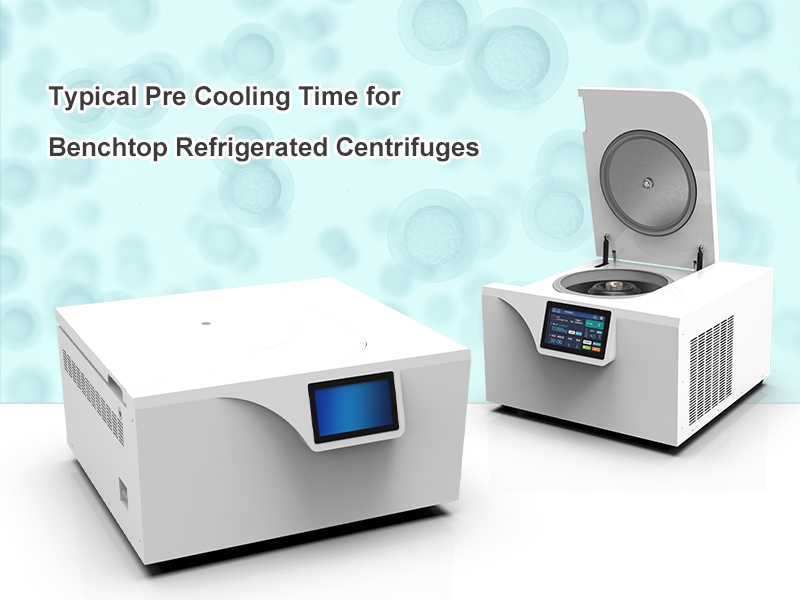
Benchtop Refrigerated Centrifuges
Benchtop models typically have smaller centrifuge chambers (usually ≤5 L) and medium-power refrigeration systems, allowing relatively fast temperature reduction. These centrifuges are widely used for micro-volume sample processing.
Typical cooling times:
Room temperature to 4°C: about 15–30 minutes
Room temperature to -20°C: about 40–80 minutes
When the ambient laboratory temperature is higher (for example, close to 30°C in summer), cooling time may increase by 10–15 minutes.
Large Floor-Standing Refrigerated Centrifuges
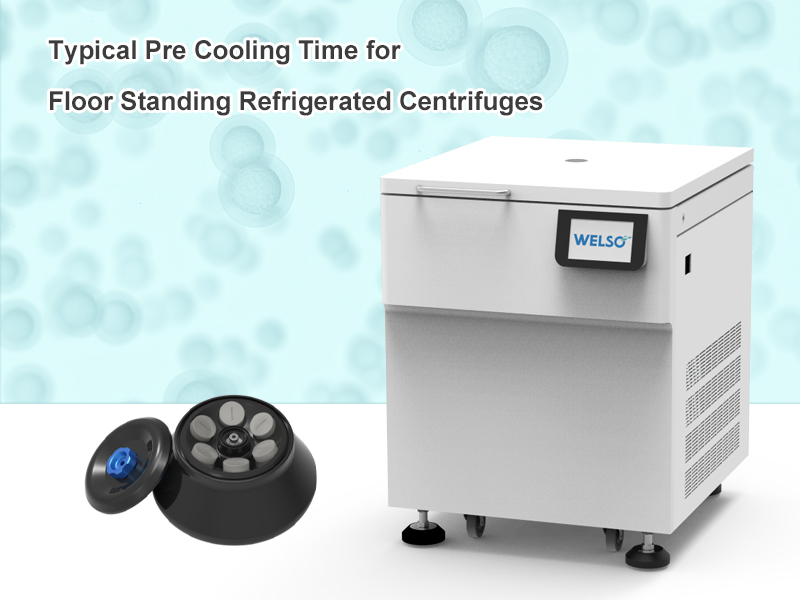
Floor-standing centrifuges are designed for large-volume sample processing. Due to their larger chambers and heavier rotors, the refrigeration system must remove more heat, which increases the cooling time.
Typical cooling times:
Room temperature to 4°C: about 30–60 minutes
Room temperature to -20°C: about 80–120 minutes
If large metal rotors or centrifuge bottles are already installed during pre-cooling, the thermal load increases and the cooling time may extend by 10–20 minutes.
Key Factors Affecting Pre-Cooling Time
The temperature control of a refrigerated centrifuge relies on a compressor-based refrigeration system, which removes heat through refrigerant circulation. Several technical factors influence cooling efficiency.
Refrigeration System Performance
The power and efficiency of the compressor determine how quickly the centrifuge can remove heat from the chamber.
Chamber Volume
Larger centrifuge chambers contain more air and internal components, requiring more heat removal and longer cooling time.
Rotor and Accessory Heat Capacity
Metal rotors have significant thermal mass. If placed inside the chamber at the beginning of pre-cooling, additional cooling capacity is required to reduce their temperature.
Laboratory Environment
Higher ambient temperature and poor air circulation increase the cooling load on the refrigeration system.
Equipment Condition
Over time, compressor efficiency may decline and condenser dust accumulation can reduce heat dissipation, leading to longer cooling times.
Is Long Pre-Cooling Necessary?
Some laboratory users start the centrifuge 1–2 hours in advance to ensure temperature stability. However, based on the operating principle of refrigeration systems, excessively long pre-cooling is usually unnecessary.
Impact on Experimental Efficiency
1. Increased waiting time
If the centrifuge only needs about 20 minutes to reach 4°C, pre-cooling for more than an hour significantly slows the workflow, especially in high-throughput experiments.
2. Higher energy consumption
Even after reaching the target temperature, the compressor continues to cycle to maintain low temperature, increasing energy usage during idle operation.
3. Possible frost formation
Prolonged low-temperature operation may cause moisture in the chamber to condense and form frost, which can reduce heat exchange efficiency and increase maintenance requirements.
Although long pre-cooling typically does not damage the centrifuge, it generally provides no additional benefit for most experiments.
How to Determine When Pre-Cooling Is Complete?
When the display shows the target temperature, the chamber and rotor may not yet be fully stabilized.
A more reliable approach is to observe temperature stability.
Recommended practice:
● After the displayed temperature reaches the set value, allow the centrifuge to run for an additional 5–10 minutes
● Ensure temperature fluctuations remain within ±1°C
● Once the temperature is stable, samples can be loaded and centrifugation can begin.
Tips for Improving Pre-Cooling Efficiency
Several practical steps can help optimize the pre-cooling process in daily laboratory work.
● Plan pre-cooling time appropriately
Start the centrifuge shortly before the experiment instead of hours in advance.
● Install the rotor near the end of cooling
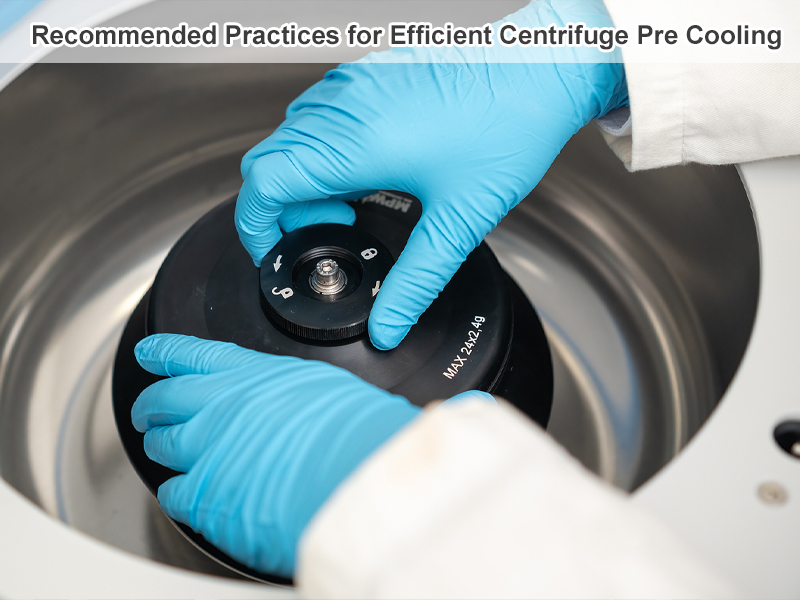
Placing the rotor into the chamber after the temperature approaches the set value can reduce thermal load.
● Minimize door opening
Frequent opening allows cold air to escape and prolongs cooling time.
● Maintain the condenser regularly
Cleaning the condenser fins ensures efficient heat dissipation and stable refrigeration performance.
Conclusion
Under typical laboratory conditions, the approximate pre-cooling time for refrigerated centrifuges is:
Benchtop Refrigerated Centrifuge
✔ 4°C: about 15–30 minutes
✔ -20°C: about 40–80 minutes
Floor-Standing Refrigerated Centrifuge
✔ 4°C: about 30–60 minutes
✔ -20°C: about 80–120 minutes
Proper pre-cooling ensures stable sample temperature during centrifugation while avoiding unnecessary waiting time and energy consumption. By planning pre-cooling steps scientifically and maintaining the equipment properly, laboratories can improve both experimental reliability and operational efficiency.



Email: info@welsobio.com
Tel: +86 21 51096910
Head Office: No. 439 Jinglian Road, Minhang District, Shanghai,China, 201108
Branch: 1-1009, National Industrial Design Park, No. 599 Jianzhu Road, Binhu, Wuxi , Jiangsu, China, 214062

Follow official account